
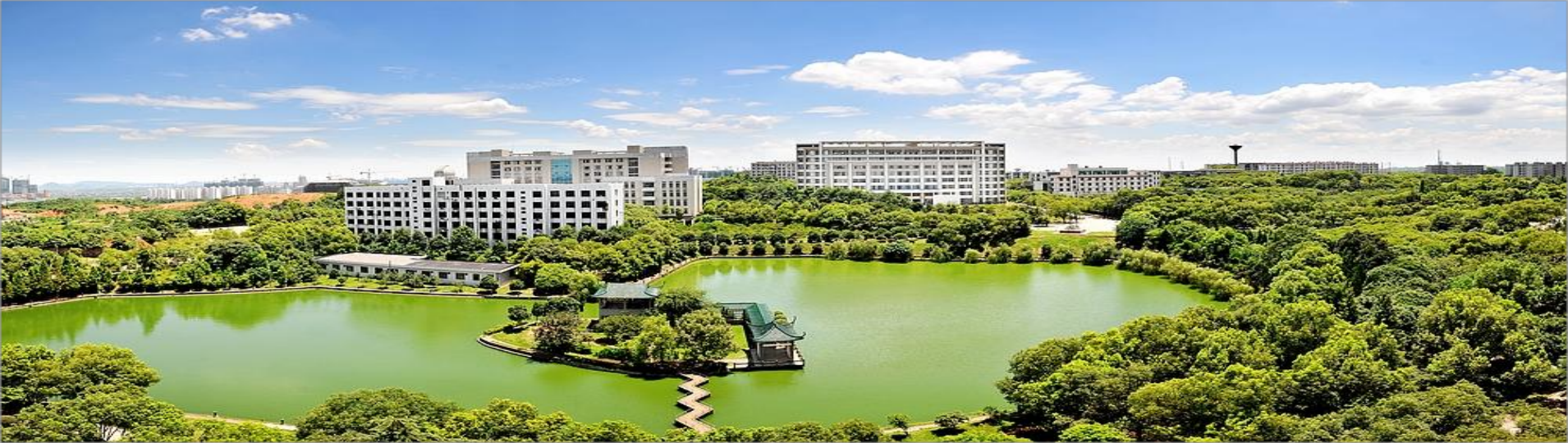
School Introduction
School of Physics and Electronic Science (SPES) traces its origins to the Physics Major of Xiangtan Normal College in 1958. SPES currently offers 4 undergraduate programs, including Physics, Electronic Information Science and Technology, Optoelectronic Information Science and Engineering, and Integrated Circuit and System Integration. Among these, the Electronic Information Science and Technology is recongnized as National First-Class Undergraduate Program, while the Physics is recongnized as one of the first batch of key disciplines in Hunan Province and Provincial First-Class Undergraduate Program. SPES also offers 4 Master's programs, such as Physics (First-Level Discipline), Professional Master's program in Electronic Information (focusing on Integrated Circuits), as well as two Professional Master's programs in Education: Subject Teaching (Physics) and Vocational and Technical Education (Information Technology). Currently, over 2,000 undergraduate and graduate students are enrolled.
SPES comprises 4 educational departments: Physics, Electronic Information Science and Technology, Optoelectronic Information Science and Engineering, and Basic Physics Laboratory Center. The Basic Physics Laboratory is recognized as a Provincial Demonstration Laboratory for Basic Courses in Hunan Province. SPES has 91 faculty and staff members, including 65 full-time teaching faculty (6 professors). Adhering to the university motto "Realism, Innovation, Honesty, Ambition" and upholding the educational philosophy of "Rooted in Hunan, Nationally Oriented, Globally Engaged," the school continuously reforms teaching and learning methodologies, fosters virtue and nurtures talent, aiming to produce high-caliber professionals who meet the needs of new economic development and social progress, with solid expertise in Physics, Electronic Science and Technology, Optoelectronic Information Science and Engineering, Integrated Circuit and System Integration, and related fields.
SPES hosts several national and provincial-level research platforms, including Key Laboratory of Intelligent Sensors and Advanced Sensing Materials of Hunan Province. It also has three research institutes: the Institute of Modern Physics, the Institute of Special Optoelectronic Devices, and the Institute of Advanced Integrated Circuits and Sensing Technology. Over the past five years, SPES has been awarded one Second Prize and two Third Prizes of the Hunan Provincial Natural Science Award, two Hunan Provincial Teaching Achievement Awards, and three university-level Teaching Achievement Awards. The school has undertaken more than 20 national-level projects (including those funded by the National Natural Science Foundation of China) and over 100 provincial/ministerial-level research projects, industry-university collaborative projects, and teaching-research reform projects. It has published over 300 papers in leading domestic and international academic journals and conference proceedings, and has been granted more than 30 national invention patents.
SPES has established multiple student innovation and entrepreneurship platforms, including the Hunan Provincial Innovation and Entrepreneurship Education Center for Physics and Optoelectronics, the Hunan Provincial New Normal Physics Innovation and Entrepreneurship Education Center, and the Hunan Provincial University-Enterprise Cooperation Innovation and Entrepreneurship Education Base for Physics Majors. Leveraging these platforms, the school has built a complementary mentorship team consisting of professional faculty, renowned scientists, and outstanding entrepreneurs. The team continuously expands innovation and entrepreneurship projects in areas such as embedded system development, artificial intelligence applications, Intelligent optoelectronic sensors and materials, and physics education technology. In recent years, over 60 innovation and entrepreneurship projects have been selected annually for the Ministry of Education's Innovation and Entrepreneurship Competition, and more than 40 teams have been incubated at the base. In the past three years, undergraduate students have won 5 national awards and over 80 provincial/ministerial awards in various academic competitions. More than 300 students have been awarded at various levels, as patent authorizations or published academic papers.

Academic Affairs Office: 0731-58291641 Experiment Center: 0731-58290524
Address: Zhixing Building, Hunan University of Science and Technology, Taoyuan Road, Xiangtan, Hunan, China 411201
Copyright © School of Physics and Electronic Science, Hunan University of Science and Technology